CLERC_FILE = (
    "https://huggingface.co/datasets/jhu-clsp/CLERC/resolve/main/"
    "teva_train_dir/train_data.jsonl.gz"
)


def cid(text: str) -> str:
    """Corpus id: a content hash, so passages shared across queries dedupe."""
    return hashlib.sha1(text.encode("utf-8")).hexdigest()[:16]


@json_cache
def build_slice(n_rows: int, n_queries: int, seed: int) -> dict:
    """Stream CLERC rows, pool ``n_rows`` of them into a corpus, pick ``n_queries`` to evaluate."""
    from datasets import load_dataset  # heavy import, keep local

    stream = load_dataset("json", data_files=CLERC_FILE, streaming=True, split="train")
    rows = []
    for row in stream:
        if (
            row.get("positive_passages")
            and len(row.get("negative_passages") or []) == 20
        ):
            rows.append(row)
        if len(rows) >= 1000:
            break

    rng = random.Random(seed)
    picked = rng.sample(rows, n_rows)
    corpus, pool = {}, []
    for row in picked:
        gold = row["positive_passages"][0]["text"]
        corpus[cid(gold)] = gold
        for neg in row["negative_passages"]:
            corpus[cid(neg["text"])] = neg["text"]
        pool.append(
            {"qid": str(row["query_id"]), "query": row["query"], "gold": cid(gold)}
        )
    # hold out the first 20 pooled rows; evaluate on the rest
    queries = rng.sample(pool[20:], n_queries)
    # sort the corpus by id so every run — live or cache replay — iterates it identically
    return {"queries": queries, "corpus": dict(sorted(corpus.items()))}


def bm25_rankings(corpus: dict[str, str], queries: dict[str, str], k: int = 100):
    """Rank every passage in the corpus by word overlap with each query."""
    import bm25s

    cids = list(corpus)
    retriever = bm25s.BM25()
    retriever.index(bm25s.tokenize([corpus[c] for c in cids], stopwords="en"))
    qids = list(queries)
    idxs, _ = retriever.retrieve(
        bm25s.tokenize([queries[q] for q in qids], stopwords="en"), k=min(k, len(cids))
    )
    return {q: [cids[i] for i in idxs[row]] for row, q in enumerate(qids)}


def gold_rank(ranked: list[str], gold: str) -> int | None:
    """1-based rank of the gold id, or None if it isn't in the list."""
    return ranked.index(gold) + 1 if gold in ranked else None


SURFACE, INK, INK2, MUTED = "#f8f8f2", "#34342f", "#34342f", "#7c7c77"
GRID, AXIS, BLUE, GREEN = "#d8d8cf", "#d8d8cf", "#5d76a2", "#6f9b52"


def bar_chart(labels: list[str], shares: list[float], title: str) -> None:
    """A small single-series bar chart of shares (0-1, shown as percentages)."""
    import matplotlib.pyplot as plt

    fig, ax = plt.subplots(figsize=(5, 3.2), facecolor=SURFACE)
    ax.set_facecolor(SURFACE)
    for side in ("top", "right"):
        ax.spines[side].set_visible(False)
    for side in ("left", "bottom"):
        ax.spines[side].set_color(AXIS)
    ax.tick_params(colors=MUTED, labelcolor=INK2, labelsize=9)
    ax.set_axisbelow(True)
    ax.grid(axis="y", color=GRID, linewidth=0.8)

    bars = ax.bar(labels, shares, width=0.55, color=[BLUE, GREEN][: len(labels)])
    ax.bar_label(
        bars,
        labels=[f"{s * 100:.0f}%" for s in shares],
        padding=4,
        color=INK,
        fontsize=11,
    )
    ax.set_ylim(0, 1.1)
    ax.set_yticks([0, 0.25, 0.5, 0.75, 1.0])
    ax.set_yticklabels(["0%", "25%", "50%", "75%", "100%"])
    ax.set_ylabel(f"share of {len(queries)} queries", color=INK2, fontsize=9)
    ax.set_title(title, loc="left", color=INK, fontsize=11)
    plt.tight_layout()
    display(fig)
    plt.close(fig)


ds = build_slice(N_ROWS, N_QUERIES, seed=0)
corpus: dict[str, str] = ds["corpus"]
queries = {q["qid"]: q["query"] for q in ds["queries"]}
golds = {q["qid"]: q["gold"] for q in ds["queries"]}

candidates = {q: ranked[:TOP_K] for q, ranked in bm25_rankings(corpus, queries).items()}

in_top_k = sum(golds[q] in candidates[q] for q in queries)
at_rank_1 = sum(candidates[q][0] == golds[q] for q in queries)

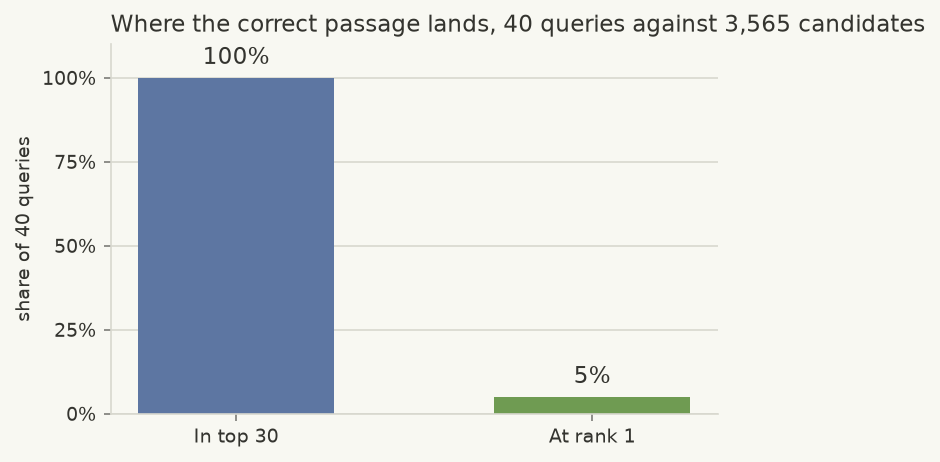
bar_chart(
    [f"In top {TOP_K}", "At rank 1"],
    [in_top_k / len(queries), at_rank_1 / len(queries)],
    f"Where the correct passage lands, {len(queries)} queries against {len(corpus):,} candidates",
)


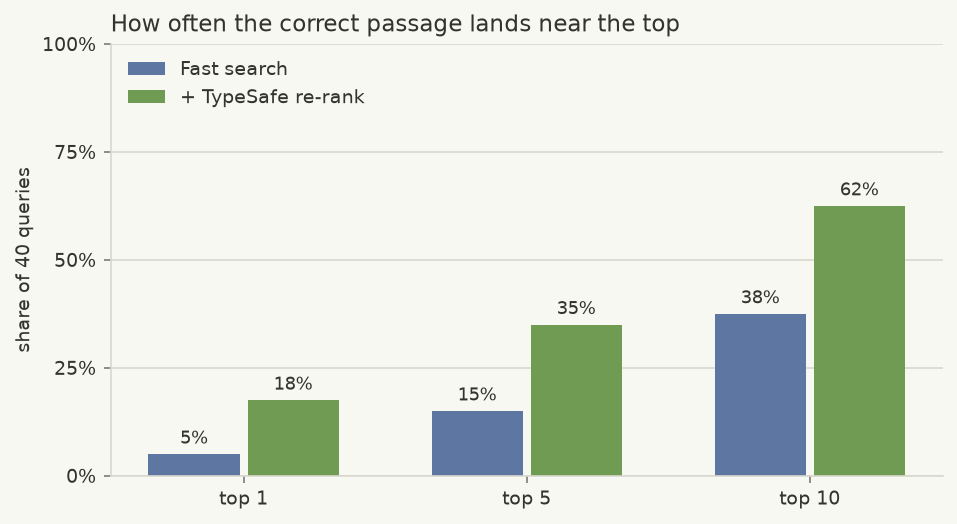
 This cookbook tests that setup on a dataset of court opinions, in
Re-ranking on a real example below.
This cookbook tests that setup on a dataset of court opinions, in
Re-ranking on a real example below.
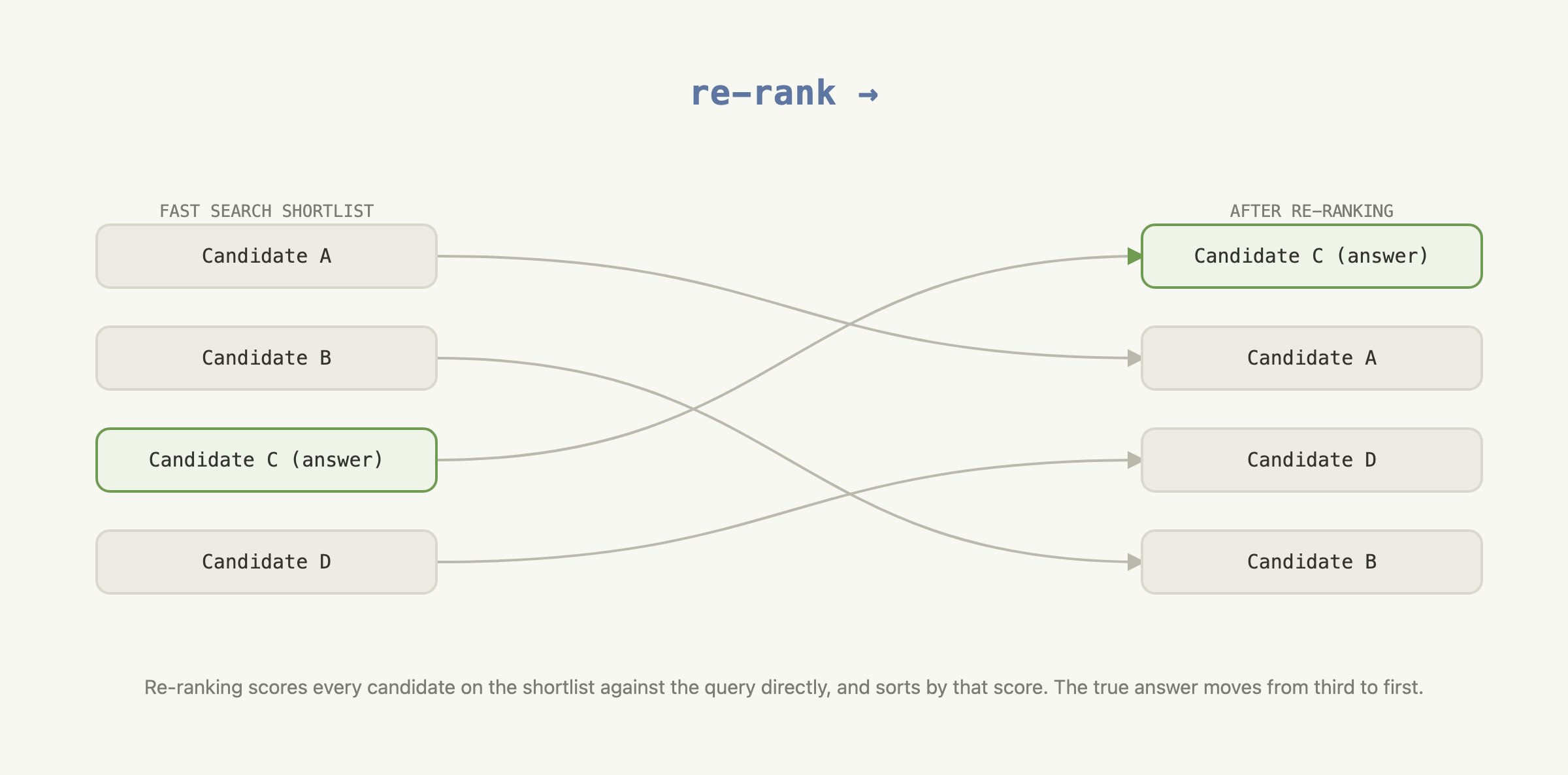 The score can come from a language model. Give it the query and one candidate together
and ask how well the candidate answers the query. Re-ranking then finds the best match
on the shortlist even when its wording differs from the query’s.
The score can come from a language model. Give it the query and one candidate together
and ask how well the candidate answers the query. Re-ranking then finds the best match
on the shortlist even when its wording differs from the query’s.